
How Shared Hosting Email Can Affect Your Business Reputation
By Divya – Support Engineer and Google Cloud Certified Digital Leader with 2+ years of experience in Google Workspace administration at XL Technologies. Her expertise includes user account creation, permission management, email configuration, security, and ticket handling. With proven skills, she ensures smooth, secure, and efficient Workspace operations for clients. At XL Technologies, Divya plays a key role in driving digital transformation through Google Cloud solutions. She is passionate about helping businesses maximize productivity and collaboration with Google Workspace.
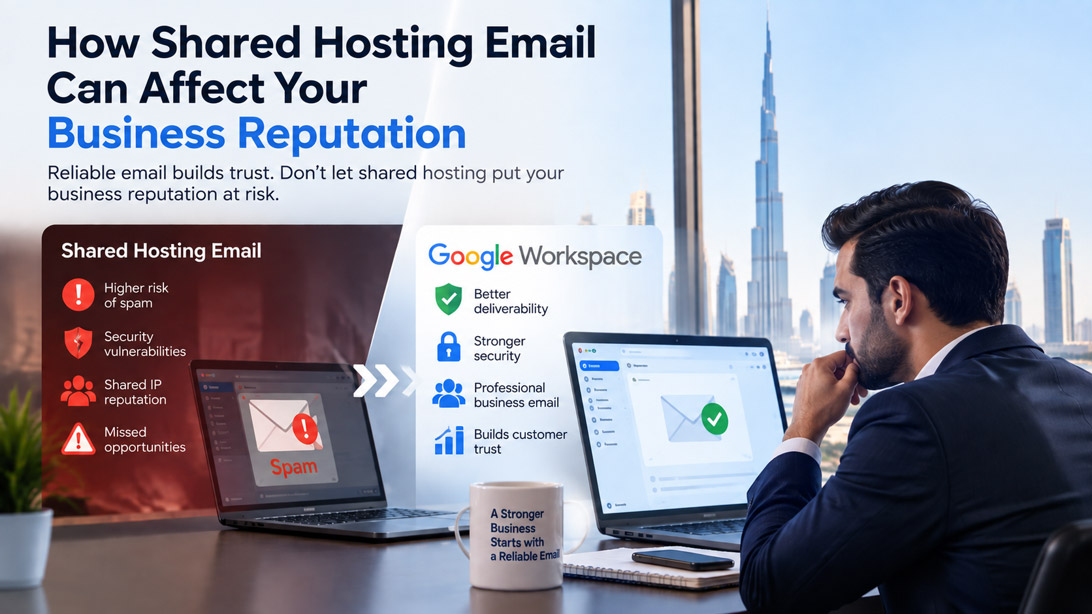
For many UAE businesses, email is still one of the most important channels for communicating with customers, suppliers, employees and business partners. Yet many companies continue to use email included with low-cost shared web hosting because it appears convenient and affordable. The problem is that shared hosting email can introduce deliverability, security and reliability issues that may eventually affect how customers perceive your business.
When an important proposal lands in spam, a quotation never reaches a customer, or an email address becomes associated with suspicious activity, the consequences go beyond a technical inconvenience. Your business can appear less professional and less reliable. In this guide, we explain how shared hosting email can affect your business reputation, what warning signs to watch for, and why moving business email to a dedicated cloud platform such as Google Workspace can be a smarter long-term approach.
What Is Shared Hosting Email?
Shared hosting is a web hosting arrangement where many websites and accounts operate on the same server infrastructure. Email services are often included as part of the hosting package, allowing businesses to create addresses such as [email protected] or [email protected].
For a new or very small business, this can seem like an economical solution. However, your business email may share infrastructure and sending resources with many other customers.
That creates an important distinction: your website hosting and your business email have different requirements.
A website can often tolerate occasional resource limitations. Business email is different. Your company depends on email being delivered reliably, securely and professionally every day.
1. Shared IP Reputation Can Affect Email Deliverability
One of the biggest concerns with shared hosting email is the reputation of the sending infrastructure.
When multiple customers send email through the same hosting environment, the reputation of that infrastructure can be influenced by the behaviour of other accounts. If another account is compromised and used to send spam, phishing messages or other unwanted email, the shared mail infrastructure may develop a poor reputation.
This does not necessarily mean your company has done anything wrong.
However, receiving mail systems evaluate multiple signals when deciding whether a message should reach the inbox. A poor sending reputation can contribute to messages being filtered, delayed or rejected.
For a UAE business, that can become a serious commercial issue.
Imagine your sales team sends a quotation to a prospective customer. The message leaves your server successfully, but the customer never sees it because it is filtered into spam. Your team may assume the customer is considering the proposal, while the customer may simply believe your company failed to respond.
The result is a reputation problem that may never be traced back to email infrastructure.
2. Your Business Emails May Look Less Reliable
When a receiving mail server is unavailable, the sending system may attempt delivery again later. This is commonly known as a retry or delivery queue.
For example, if a customer sends a quotation request while your server is offline, the message may remain in the sender’s system until delivery is possible. However, not every message is guaranteed to remain available indefinitely.
If the outage continues for too long, the sender may receive a delivery failure notification. This means the customer may believe the message has been sent, while your business has not received it.
3. Poor Email Security Can Put Your Reputation at Risk
Email accounts are attractive targets for attackers because they can provide access to sensitive conversations, documents, invoices and customer information.
Shared hosting does not automatically mean that an email system is insecure. The real issue is whether the provider offers the security controls, monitoring and administration your business needs.
A compromised mailbox can be used to send fraudulent messages appearing to come from your company. Attackers may impersonate employees, request payments, send malicious attachments or target customers and suppliers.
The UAE has placed significant emphasis on cybersecurity and creating a secure digital environment for businesses. For companies handling customer and commercial information, email security should therefore be considered part of overall business risk management.
4. Missing Email Authentication Can Increase Deliverability Problems
Email authentication is another critical consideration.
Technologies such as SPF, DKIM and DMARC help receiving systems verify whether messages claiming to come from your domain are legitimate.
SPF identifies authorized email senders for your domain. DKIM adds a cryptographic signature that helps verify the message’s authenticity. DMARC provides a policy framework for handling messages that fail authentication.
Google’s current sender guidance requires senders to meet authentication and other technical requirements when sending to Gmail accounts. Google recommends SPF and DKIM, while higher-volume senders must also implement DMARC.
The challenge for smaller businesses is that simply owning a domain does not guarantee that these controls have been configured correctly.
An incorrectly configured DNS record, forgotten email sender or poorly managed migration can cause legitimate messages to be treated suspiciously.
5. Email Problems Can Directly Affect Customer Trust
The biggest cost of unreliable business email is not always visible on an IT invoice.
It can be a missed opportunity.
Consider a UAE real estate company whose agent sends a property proposal to a potential buyer. Or a consulting firm sending a project quotation. Or an e-commerce company sending an order confirmation.
If these messages consistently fail to reach customers, the business can lose enquiries, delay transactions and create unnecessary customer-service problems.
Customers do not usually think about SMTP servers, DNS records or IP reputation.
They simply think:
“This company never replied to me.”
That is why email infrastructure is ultimately a reputation issue, not just a technical issue.
6. Shared Hosting May Limit Business Collaboration
Traditional hosting email is often designed primarily around sending and receiving messages.
Modern businesses need more.
Teams increasingly need shared calendars, cloud storage, document collaboration, video meetings, chat, mobile access, administrative controls and secure file sharing.
This is where a cloud productivity platform can provide a broader business advantage.
Google Workspace combines Gmail with tools such as Drive, Meet, Chat, Calendar and Docs, allowing employees to communicate and collaborate within one managed environment.
For growing UAE companies, moving beyond basic hosting email can therefore be part of a wider digital transformation strategy rather than simply an email upgrade.
Why Google Workspace Can Be a Better Business Email Platform
Google Workspace provides custom business email on your own domain alongside cloud productivity and security capabilities.
Google states that Gmail for Workspace includes AI-powered threat defenses and enterprise-grade security and privacy controls.
For businesses, the benefits can include:
- Professional email using your company domain
- Centralized administration through the Admin Console
- Email authentication and security controls
- Cloud-based access from computers and mobile devices
- Google Drive for business file storage
- Google Meet for video meetings
- Google Calendar for scheduling
- Google Chat for team communication
- Collaboration through Docs, Sheets and Slides
- Security and access management features
- AI-powered capabilities through Google’s Gemini ecosystem
The objective is not simply to replace one mailbox with another. It is to create a more reliable and scalable environment for business communication and collaboration.
Should You Move Your Website Away From Shared Hosting?
Not necessarily.
Your website and email do not have to use the same hosting provider.
A business can continue using shared hosting for its website while routing business email through a dedicated professional email platform.
This separation can make sense because the requirements are different. Your website needs web hosting. Your employees need dependable business communication and collaboration.
If your company is already experiencing spam-folder problems, bounced emails, unexplained delivery failures or security concerns, reviewing your current email infrastructure is a sensible first step.
How to Move From Shared Hosting Email to Google Workspace
A successful migration should be carefully planned rather than treated as a simple DNS change.
1. Assess Your Current Environment
Identify all users, aliases, groups, domains, mailboxes, storage requirements and third-party systems that currently send email.
2. Plan the Migration
Determine what data needs to be moved and how the transition will affect employees, customers and automated systems.
3. Configure Google Workspace
Set up users, domains, security policies, administrative controls and email authentication before switching production traffic.
4. Migrate Existing Email and Data
Email and other business data can be transferred from platforms such as cPanel hosting, Microsoft 365, Zoho or Exchange.
5. Test and Validate
Confirm that users can send and receive messages, historical email is available and important business workflows continue working.
6. Go Live With Support
A structured cutover minimizes disruption and gives employees access to assistance if they encounter issues after migration.
For UAE businesses without an internal IT team, working with an experienced Google Workspace partner can simplify the process.
Conclusion
Your business email plays an important role in shaping customer trust and professional reputation. While shared hosting email may appear cost-effective, issues such as poor deliverability, security concerns, and limited business collaboration can affect communication and create a less professional experience for customers.
Moving to Google Workspace gives UAE businesses a more secure, reliable, and scalable platform for professional email and collaboration. With expert setup, migration, security configuration, and ongoing support, XL Technologies can help your business transition smoothly and build a stronger foundation for reliable business communication.
Frequently Asked Questions
Can shared hosting cause emails to go to spam?
It can contribute to deliverability problems, particularly when the sending infrastructure has a poor reputation or email authentication is incorrectly configured. Email delivery also depends on other factors, so spam placement should not automatically be attributed to shared hosting alone.
What are SPF, DKIM and DMARC?
They are email authentication technologies that help receiving systems verify legitimate email and reduce domain spoofing. Proper configuration is an important part of modern business email management.
Can I keep my website on shared hosting and move only email?
Yes. Website hosting and business email can be hosted separately. Many businesses use a web hosting provider for their website and a dedicated cloud service for business email.
Can you migrate email from cPanel hosting to Google Workspace?
Yes. XL Technologies’ Google Workspace migration services can support businesses moving email and data from cPanel and other platforms to Google Workspace.
Will email migration cause downtime?
A properly planned migration can minimize disruption. However, no responsible provider should promise that every migration is literally risk-free. The migration plan, DNS configuration, source system and business requirements all influence the transition.
Why should a UAE business use a Google Workspace partner?
A local partner can provide assistance with licensing, setup, migration, configuration, training and ongoing support. This can be particularly valuable for businesses that do not have dedicated internal IT resources.