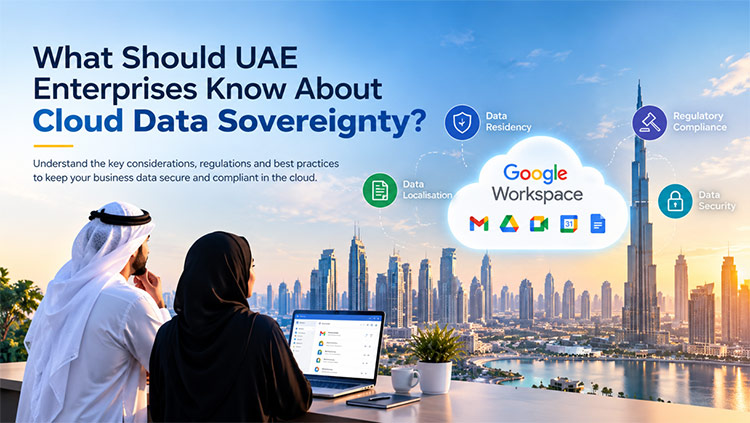
What Should UAE Enterprises Know About Cloud Data Sovereignty?
By Divya – Support Engineer and Google Cloud Certified Digital Leader with 2+ years of experience in Google Workspace administration at XL Technologies. Her expertise includes user account creation, permission management, email configuration, security, and ticket handling. With proven skills, she ensures smooth, secure, and efficient Workspace operations for clients. At XL Technologies, Divya plays a key role in driving digital transformation through Google Cloud solutions. She is passionate about helping businesses maximize productivity and collaboration with Google Workspace.
- What Is Cloud Data Sovereignty?
- Does All Business Data Have to Stay in the UAE?
- Why Cloud Data Sovereignty Matters to UAE Enterprises
- What Does This Mean for Google Workspace?
- Data Regions Do Not Cover Everything
- How UAE Enterprises Can Build a Data Sovereignty Strategy
- A Practical UAE Example
- Cloud Sovereignty Checklist for UAE Businesses
- How an Experienced Google Workspace Partner Can Help
Cloud adoption is accelerating across the UAE, but for enterprises, moving workloads and business data to the cloud is no longer simply a question of cost, scalability, or productivity. Where data is stored, where it is processed, who can access it, and which laws may apply to it are increasingly important considerations.
For UAE organisations using cloud platforms for email, documents, collaboration, customer information, HR records, and financial data, understanding cloud data sovereignty can help reduce regulatory, security, and operational risk. The UAE’s National Cloud Security Policy specifically addresses data location and sovereignty, while the UAE Personal Data Protection Law establishes requirements around the processing and cross-border transfer of personal data.
This guide explains what UAE enterprises should know about cloud data sovereignty, how it differs from data residency and localisation, which industries need additional attention, and what businesses should consider when selecting cloud services such as Google Workspace.
What Is Cloud Data Sovereignty?
Cloud data sovereignty refers to an organisation’s ability to understand and control where its data is stored and processed, who can access it, and which legal or regulatory frameworks govern that data.
Three terms are often used interchangeably, but they describe different concepts:
Data Residency
Data residency refers primarily to where data is physically stored or processed.
For example, an organisation may require certain information to remain within a particular geographic region.
Data Localisation
Data localisation goes further. It means that applicable laws or regulations require certain categories of data to remain within a particular country or jurisdiction.
This can be especially relevant for regulated sectors and specific categories of sensitive information.
Data Sovereignty
Data sovereignty considers the broader question of which laws and authorities may have jurisdiction over data and who ultimately controls access to it.
Consequently, storing data in a UAE data centre does not automatically mean that the data is fully sovereign from every legal perspective.
For UAE enterprises, this distinction is critical when evaluating cloud providers and contracts.
Does All Business Data Have to Stay in the UAE?
No. There is not one blanket rule requiring every type of business data belonging to every UAE company to remain inside the UAE.
The requirements can depend on the type of data, the organisation, the industry, the applicable regulator, and the specific contractual or regulatory obligations involved.
The UAE Personal Data Protection Law establishes requirements for personal data processing and cross-border transfers. The law provides mechanisms under which personal data may be transferred outside the UAE, subject to specified conditions and safeguards.
At the same time, sector-specific requirements can impose stricter obligations.
For example, Central Bank rules governing outsourcing include requirements concerning confidential data, data ownership, security, outsourcing outside the UAE, and the storage of certain records within the State.
Healthcare organisations can face additional requirements. Dubai Health Authority standards, for example, have included requirements concerning UAE-based cloud storage and restrictions on transferring certain health information outside the country.
The right question for an enterprise is therefore not simply, “Is our cloud data in the UAE?”
It is:
Which data do we have, where does it go, who can access it, and what rules apply to that particular data?
Why Cloud Data Sovereignty Matters to UAE Enterprises
Data sovereignty should be considered during cloud procurement and architecture decisions because it can affect several areas of the business.
1. Regulatory Compliance
The UAE’s National Cloud Security Policy identifies data location and sovereignty as an important cloud-consumer consideration. It also highlights governance, contractual agreements, data security, and lifecycle management.
Enterprises should therefore establish clear requirements before selecting a cloud service.
2. Data Security
Data sovereignty is not only about geography.
Businesses should also understand:
- Who has administrative access?
- Where are backups stored?
- Where is data processed?
- Where are logs and metadata maintained?
- Can support personnel access customer information?
- How are encryption keys controlled?
- What happens when the contract ends?
A cloud provider’s data-centre location is only one part of the security picture.
3. Business Continuity
Enterprises should know how their information can be recovered, exported, or migrated if they change providers.
Data portability can reduce dependency on a single cloud platform and support continuity planning.
4. Customer and Partner Requirements
Large UAE organisations may increasingly encounter procurement questionnaires asking about data location, encryption, subcontractors, incident response, and cross-border transfers.
Being able to answer these questions clearly can strengthen vendor and customer confidence.
What Does This Mean for Google Workspace?
Google Workspace is widely used for business email, documents, cloud storage, meetings, collaboration, and AI-assisted productivity.
Google provides data-region controls that allow eligible customers to control the geographic location of covered data. However, businesses must understand exactly what those controls cover.
Google’s current documentation states that available data-region choices include the United States, Europe, or no preference. In other words, organisations should not assume that selecting Google Workspace automatically means their Workspace data is hosted in the UAE.
This is an important consideration for UAE organisations with strict localisation requirements.
Google also states that some Workspace features rely on services that process data globally. Advanced data-region controls can help organisations with stringent location requirements manage some of these considerations, but administrators should evaluate the impact on functionality before enforcing restrictive policies.
Which Google Workspace Plans Provide Data-Region Controls?
Google’s current Workspace documentation shows data-region capabilities across selected editions.
Business Standard and Business Plus support fundamental data-region controls, while Enterprise editions provide additional capabilities. Enterprise Plus provides more granular enterprise data-region controls, including data-at-rest and data-processing policies for organisational units or groups.
For enterprises with stringent sovereignty or compliance requirements, choosing the right Workspace edition is therefore an architectural and compliance decision—not merely a licensing decision.
Data Regions Do Not Cover Everything
Another important consideration is scope.
Google explains that data regions cover specified customer-supplied data and Workspace services, but certain information—including some logs or cached content—is not covered by data-region policies.
This means organisations should avoid making broad statements such as:
“All our Google data is stored in one region.”
Instead, compliance and IT teams should document exactly which data and services are covered.
This is particularly important when using integrations, third-party applications, APIs, security tools, backup systems, or other services connected to Google Workspace.
How UAE Enterprises Can Build a Data Sovereignty Strategy
A practical approach starts with a data and application inventory.
Step 1: Classify Your Data
Identify categories such as:
- Customer personal data
- Employee and HR information
- Financial information
- Confidential business documents
- Intellectual property
- Health information
- Government-related information
- Public or low-risk information
Step 2: Map Data Flows
Document where information is:
Created → Stored → Processed → Backed Up → Shared → Exported → Deleted
Include third-party applications, integrations and cloud subprocessors.
Step 3: Identify Regulatory Requirements
Determine whether your organisation falls under additional requirements from regulators or special jurisdictions.
Financial institutions, healthcare providers, government entities and businesses operating within financial free zones may have requirements that differ from those applicable to a typical private-sector organisation.
Step 4: Evaluate the Cloud Provider
Ask providers for specific answers about:
- Data-centre locations
- Data processing locations
- Backup locations
- Subprocessors
- Administrative access
- Encryption
- Encryption-key management
- Support access
- Data retention
- Data deletion
- Data portability
- Incident notification
Step 5: Configure the Platform
Once the requirements are clear, configure the cloud environment accordingly.
For Google Workspace, this can involve selecting an appropriate edition, configuring data-region policies, strengthening administrator controls, implementing security policies, and reviewing which services are covered.
Google also offers client-side encryption capabilities for eligible Workspace customers, allowing organisations to maintain greater control over encryption keys.
A Practical UAE Example
Consider a Dubai-based company using Google Workspace for Gmail, Drive, Meet and employee collaboration.
The company may have employees working from Dubai while its customers operate across the GCC, Europe and Asia.
Rather than asking only whether Google Workspace is “UAE hosted,” the IT and compliance teams should establish:
- Which information is personal or regulated.
- Which Workspace services contain that information.
- Where covered data can be stored and processed.
- Which information may be transferred internationally.
- Which administrators and third parties can access the environment.
- Whether sector-specific regulations impose additional requirements.
- Whether the selected Workspace edition provides the required controls.
This approach produces a much more defensible compliance position than relying on a simple “cloud versus on-premises” decision.
Cloud Sovereignty Checklist for UAE Businesses
Before signing a cloud contract, ask:
- Where is my data stored?
- Where is it processed?
- Where are backups maintained?
- Which data is covered by residency controls?
- Which services process data globally?
- Who can access my data?
- Where are support teams located?
- Who controls the encryption keys?
- Which subprocessors are involved?
- What happens when data leaves the UAE?
- Can I export my data if I change providers?
- Which UAE or sector-specific regulations apply?
How an Experienced Google Workspace Partner Can Help
Cloud sovereignty is not something organisations should attempt to solve through licensing alone.
A qualified Google Workspace partner can help businesses assess their current environment, select the appropriate Workspace edition, configure security and administrative controls, migrate data, establish policies, and train administrators and users.
For UAE organisations, local expertise can also make it easier to align technology decisions with business, contractual, and regulatory requirements.
XL Technologies provides Google Workspace setup, migration, security configuration, administration, training, licensing, and ongoing support for UAE businesses. Its service offering includes migration from platforms such as Microsoft 365, cPanel, Zoho and Exchange, as well as security hardening, admin console configuration, and ongoing support.
Frequently Asked Questions
Is cloud data sovereignty the same as data residency?
No. Data residency focuses mainly on where data is stored or processed, while data sovereignty considers the broader legal and control environment governing that data.
Does UAE law require all company data to remain inside the UAE?
Not universally. Requirements depend on the data, organisation, sector and applicable regulations. The UAE Personal Data Protection Law establishes requirements for cross-border personal-data transfers, while certain regulated sectors can have additional requirements.
Does Google Workspace store all UAE business data in the UAE?
Businesses should not assume this. Google’s current data-region options for covered Workspace data include the United States and Europe, rather than a general UAE region.
Which Google Workspace plan is suitable for organisations with strict data requirements?
The appropriate edition depends on the organisation’s requirements. Enterprise Plus provides more granular data-region capabilities and advanced controls than standard business editions.
Can a UAE company use an overseas cloud provider?
Potentially, but the organisation must assess applicable laws, sector regulations, contractual requirements, security controls and cross-border data-transfer obligations before doing so.
What should businesses check before moving to Google Workspace?
Businesses should assess data classification, regulatory obligations, data-region coverage, processing locations, administrator access, encryption, subprocessors, integrations, backup requirements and data portability before migration.