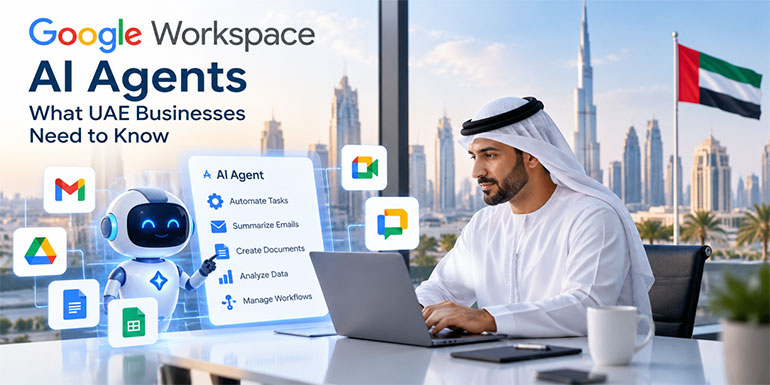
Google Workspace AI Agents: What UAE Businesses Need to Know
By Divya – Support Engineer and Google Cloud Certified Digital Leader with 2+ years of experience in Google Workspace administration at XL Technologies. Her expertise includes user account creation, permission management, email configuration, security, and ticket handling. With proven skills, she ensures smooth, secure, and efficient Workspace operations for clients. At XL Technologies, Divya plays a key role in driving digital transformation through Google Cloud solutions. She is passionate about helping businesses maximize productivity and collaboration with Google Workspace.
- What Are Google Workspace AI Agents?
- Google Workspace Studio vs. Gemini: What's the Difference?
- 5 Practical AI Agent Use Cases for UAE Businesses
- Why AI Agent Governance Matters in the UAE
- Are Google Workspace AI Agents Suitable for Small and Medium Businesses?
- How UAE Businesses Should Prepare for AI Agents
- Why Google Workspace Is Becoming an Agentic Workplace Platform
- How XL Technologies Can Help UAE Businesses Adopt Google Workspace AI
Artificial intelligence is moving beyond chatbots and content generation. For UAE businesses, the next stage is AI agents that can understand business context, coordinate tasks, and automate multi-step workflows. Google Workspace is increasingly bringing this agentic approach into the applications employees already use every day, including Gmail, Drive, Docs, Sheets and Chat.
For businesses in Dubai, Abu Dhabi, Sharjah and across the UAE, this creates an opportunity to automate repetitive work without introducing an entirely separate AI platform. In this guide, we explain what Google Workspace AI agents are, how Workspace Studio works, where UAE businesses can use agents, what security and governance issues to consider, and how to prepare your organization for responsible adoption.
What Are Google Workspace AI Agents?
Traditional automation follows fixed rules: when X happens, do Y. AI agents are designed to handle more flexible workflows by interpreting information, reasoning through tasks and taking actions based on defined instructions.
Google Workspace Studio is Google’s environment for creating, managing, and sharing AI agents within Workspace. Google says Studio can create agents without coding and automate workflows across Workspace applications.
For example, a UAE company could create a workflow that:
- Summarizes an upcoming meeting using relevant information.
- Extracts action items and posts them in Google Chat.
- Drafts follow-up emails.
- Saves email attachments to a designated Drive folder.
- Labels high-priority emails.
- Creates or updates business documents based on workflow triggers.
This is an important distinction: the goal isn’t simply to ask Gemini a question. The agent can become part of an ongoing business process.
Google Workspace Studio vs. Gemini: What's the Difference?
Gemini provides AI assistance inside Google Workspace. Workspace Studio goes a step further by allowing organizations and users to build repeatable, automated flows around that intelligence.
Google describes Studio as the place to design, manage and share AI agents in Workspace. Current Google documentation also shows that workflows can use triggers such as events or schedules and then perform multiple actions.
Think of the distinction this way:
Gemini:
“Summarize these meeting notes.”
AI agent:
“After every weekly sales meeting, summarize the discussion, identify action items, post them to the sales Chat space, save the summary to Drive and draft a follow-up email.”
The second workflow has a trigger, context, multiple steps and an intended business outcome.
5 Practical AI Agent Use Cases for UAE Businesses
1. Sales Follow-Up Automation
Sales teams can spend significant time moving information between meetings, emails, spreadsheets and CRM systems.
An agent could summarize meeting discussions, identify next steps, prepare follow-up drafts and organize supporting documents. With appropriate integrations, Google says Workspace agents can also interact with third-party services.
This can be particularly useful for UAE businesses managing high volumes of leads across Dubai, Abu Dhabi and other emirates.
2. HR Request Management
An internal HR agent could help categorize employee requests, locate relevant company policies and route issues to the appropriate team.
For example, a leave-related request could trigger a workflow that identifies the relevant policy document, summarizes the applicable process and notifies the HR team.
Sensitive HR information should still be governed by appropriate access permissions and human review.
3. Finance and Administration
Finance teams can use automation to organize incoming documents, summarize information and route requests.
For example, an agent could identify attachments arriving in a finance mailbox, store them in a controlled Drive location and notify the relevant employee.
The important principle is to automate administrative preparation, while keeping approvals and financially consequential decisions under appropriate human control.
4. Customer Service
AI agents can help support teams summarize customer conversations, identify common issues and prepare response drafts.
Instead of employees searching through multiple emails and documents, an agent can help bring relevant Workspace information together and prepare the next action.
5. Management Reporting
Managers frequently spend hours collecting information for weekly or monthly reports.
A carefully designed agent can help gather information from approved Workspace sources, summarize developments and create draft reports or presentations. Google has also introduced agentic capabilities that can work across Workspace applications to create formatted Docs, Sheets and Slides based on user direction.
Why AI Agent Governance Matters in the UAE
The biggest mistake businesses can make is treating AI agents as ordinary productivity software.
An agent may have access to email, documents, calendars, shared drives and other business information. If it can also perform actions, the potential impact of incorrect permissions or poorly designed workflows becomes greater.
The UAE’s official Personal Data Protection Law establishes requirements around personal-data processing, confidentiality, security and certain cross-border transfers.
The UAE’s AI Charter also emphasizes responsible AI, privacy, data security, transparency, human oversight and governance.
The UAE’s National Cyber Security Policy for Artificial Intelligence further highlights areas including access controls, protection of AI data, operational safety, human oversight, monitoring and incident response.
For businesses, this means an AI-agent strategy should include:
- Least-privilege access: Give agents only the information and permissions they actually need.
- Human approval: Require review for sensitive or high-impact actions.
- Auditability: Maintain visibility into what workflows are doing.
- Data classification: Identify confidential, personal and business-critical information.
- Testing: Test agents against incorrect instructions and unexpected inputs.
- Clear ownership: Assign responsibility for every production agent.
- Lifecycle management: Review and retire agents that are no longer required.
Google has itself introduced an AI control center designed to provide organizations with centralized visibility and more granular security, governance and auditing controls for Gemini and agentic solutions accessing Workspace data.
Are Google Workspace AI Agents Suitable for Small and Medium Businesses?
Yes—but businesses should start with low-risk, high-value workflows.
A 20-person company doesn’t need to build an elaborate autonomous AI system on day one. A better approach is to identify repetitive tasks that consume employee time but do not require unrestricted decision-making.
Good starting points include:
- Meeting summaries
- Internal notifications
- Email classification
- Document organization
- Routine report preparation
- Follow-up reminders
- Knowledge retrieval
- Administrative workflows
Google currently lists Workspace Studio availability across Business and Enterprise editions, with eligibility and feature availability depending on the specific Workspace edition and configuration.
How UAE Businesses Should Prepare for AI Agents
Before deploying an agent, ask five questions:
1. What business problem are we solving?
Start with a measurable process—not the technology.
2. What information does the agent need?
Map the exact Gmail, Drive, Calendar, Chat or third-party data required.
3. What can the agent actually do?
Separate actions that require no approval from actions that should require human confirmation.
4. Who owns the workflow?
Every production agent should have a business owner and an IT/security owner.
5. How will success be measured?
Track time saved, error rates, employee adoption, response times and business outcomes.
This approach turns AI agents from an experiment into a controlled productivity initiative.
Why Google Workspace Is Becoming an Agentic Workplace Platform
The broader direction from Google is clear: Workspace is evolving from a collection of productivity applications into an environment where AI can understand relationships between documents, conversations, projects and people.
Google’s Workspace Intelligence initiative is designed to provide unified, real-time context for agentic work across Workspace.
For businesses, that matters because context is what makes automation useful. An agent that understands only one isolated document is limited. An agent that can securely work with the right email, files, conversations and business processes can potentially automate much more meaningful work.
How XL Technologies Can Help UAE Businesses Adopt Google Workspace AI
Implementing AI agents successfully starts with a well-configured Workspace environment.
XL Technologies provides Google Workspace setup, migration, Admin Console configuration, security hardening, training, monitoring, licensing and ongoing support for businesses across the UAE. Its current Google Workspace service page also highlights Gemini-powered productivity, MFA, device management, data protection and access controls.
That foundation matters because AI automation is only as reliable as the environment around it. Businesses should first establish appropriate users, groups, permissions, security policies and data structures before introducing increasingly sophisticated agentic workflows.
Whether your organization is migrating from Microsoft 365, cPanel, Zoho or another platform, a structured implementation can help establish the right foundation for Workspace and future AI adoption.
Frequently Asked Questions
What is a Google Workspace AI agent?
A Google Workspace AI agent is an AI-powered workflow that can interpret instructions and information, then perform multiple tasks across Workspace applications according to defined triggers, steps and permissions.
Is Google Workspace Studio the same as Gemini?
No. Gemini provides AI assistance, while Workspace Studio provides a way to design and manage automated workflows and AI agents using Gemini.
Can AI agents access Gmail and Google Drive?
They can work with Workspace information when the relevant services, permissions and administrator policies allow it. Access should always be limited to the data required for the workflow.
Are Google Workspace AI agents secure for UAE businesses?
They can be deployed with enterprise security and governance controls, but security also depends on how the organization configures permissions, data access, workflows and human approvals. UAE businesses should evaluate deployment against their legal, contractual and regulatory obligations.
Can small businesses in Dubai use Workspace Studio?
Yes. Google currently lists Workspace Studio for eligible Business and Enterprise Workspace editions, although specific features and access can vary by edition and administrator configuration.
Should an AI agent be allowed to make business decisions automatically?
Not necessarily. For sensitive activities—such as financial approvals, HR decisions, contractual actions or external communications—businesses should consider human approval and clearly defined authorization boundaries.